2026 Bowman Chrome Preview: The International Class
2026 Bowman Chrome Preview: The International Class and Who Actually Fits the Mold
Bowman Chrome lands in September, and the headline is the 2026 international class getting their first Chrome autos. The bonuses tell you who signed big. The Dominican Summer League is starting to tell you who can hit. Those aren't always the same list.
The 2026 international signing period opened January 15 with a genuinely deep top tier. Venezuela owns three of the top four ranking spots, a Venezuelan-born player topped the class for the first time since these rankings began in 2012, and the Dominican Republic pipeline is as full as always. In September, almost every name on that list gets a Bowman Chrome 1st auto, the chase everyone waits on, and they all hit the market at once.
So this is the moment to figure out who's worth paying attention to before the cards exist. I'm going to lean on two things: the rankings, and what these kids are actually doing in their first pro summer.
How I'm reading the summer numbers
A quick honesty check before anyone gets excited about a .350 line. The Dominican Summer League is a hitters' league, and it's played by 16 and 17 year olds who signed six months ago. It's very hard to predict anything either way from it. Gaudy batting averages are cheap, cold starts are noise, and the sample sizes are tiny.
Two things carry more weight for me than the batting average. First is plate discipline. A teenager walking as often as he strikes out in his first pro reps is the number I keep coming back to, because it travels better than surface average. Second, and this is the one people skip: because the DSL tilts toward hitters, a young arm who misses bats there is a bigger signal than another teenager hitting .330. If a pitcher from this class is dominating the DSL, that's worth more of your attention than most of the bats.
With that framing, here's the class.
The headliners
Luis Hernández, SS, San Francisco Giants
The class leader and the biggest bonus of the period at $5 million, which was nearly the Giants' entire pool. He's a 17-year-old shortstop out of Venezuela, the first Venezuelan-born player to top an international class since these rankings began in 2012, and the scouting profile is loud: a plus-plus hit tool and power that projects to around 25 homers as the frame fills out. He runs average, and contrary to the early book, the arm plays as a real plus at short.
Here's the part our data adds. The Giants have moved him fast: a brief DSL look, then the stateside complex, and now Low-A ball, where he was promoted in late July as a 17-year-old. That's an aggressive, confident track, and he has among the most playing time in the class. He's hitting .278 with 8 home runs across levels on the season, and he's already climbed inside the overall top 100 prospects.
Signing: $5.0M, January 15 Build: 5'10", 172, R/R, age 17 The profile: Elite hit tool, average run, plus arm, power that projects to about 25 homers Summer so far: promoted to Low-A in late July; .278 with 8 HR across levels on the season, with the plate discipline still a work in progress
That last line is the catch. Hernández has the biggest bonus, the highest rank, and as much power as any middle infielder in the class, but his plate discipline is the weakest of the group I looked at. His profile is power and aggression, not patience. That doesn't make him a worse prospect, the tools are the best in the class, but it's a different bet than the mold I usually chase, and the Chrome 1st auto will price like a top-of-the-board name regardless.
Francisco Renteria, OF, Philadelphia Phillies
The No. 3 international prospect and, at $4 million, the second-biggest bonus in the class. Scouts inside the Phillies called it the best mix of tools they'd seen and put a Konnor Griffin comp on it. He's a big, physical 17-year-old, 6-foot-3 and already 216 pounds, with a contact-first hit tool and plus-plus raw power. The open question is whether that frame stays in center or slides to a corner, which would raise the offensive bar.
He's backing it up. Renteria is the one player in this group carrying a real rank in our system and raking at the same time, hitting .350 with 8 home runs and a near-even walk-to-strikeout ratio in his debut, and he's landed on the Dominican Summer League midseason all-star team.
Signing: $4.0M, January 15 Build: 6'3", 216, R/R, age 17 The profile: Contact monster, plus-plus power, corner-or-center question Summer so far: .350, 8 HR, roughly even walks and strikeouts, a midseason all-star
Angeibel Gomez, OF, Kansas City Royals
Gomez signed for a reported $2.9 million and might be my favorite profile in the class on paper. He's a true center fielder with a plus glove and arm, and the bat is built on the exact thing I weight most: he walked more than he struck out on the amateur circuit and he's doing it again now. He won an amateur league MVP hitting .370, and the makeup reports are glowing. The only real knock is present power, he's 6-foot-2 but a lean 173 pounds, so the pop is projection until he adds strength.
His summer line is the most complete in the class: .348 with a 1.048 OPS, 6 home runs, 13 steals, and a walk-to-strikeout ratio well above one. He's climbed to No. 4 in the Royals system and onto the overall top 100.
Signing: $2.9M, January 15 Build: 6'2", 173, R/R, age 17 The profile: Plus-glove center fielder, elite discipline, power projection Summer so far: .348, 1.048 OPS, 6 HR, 13 SB, walked well more than he struck out; a midseason all-star
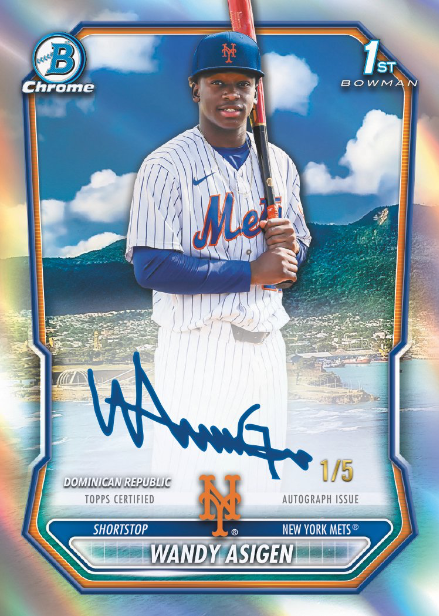
The name to file next to Gomez is Wandy Asigen, the 16-year-old Mets shortstop and No. 2 international prospect, who signed for $3.9 million after flipping from the Yankees. The pro sample is still small, but he's hitting .279 with a huge .470 on-base, the kind of disciplined start that backs up how the industry values the long-term bat.
The discipline group
These are the names that fit the profile I like to buy early: young, up the middle, and controlling the strike zone in their first pro reps. Most of them are still unranked, which is exactly why they're interesting before Chrome prices them.
Jaider Suárez, SS, Kansas City Royals
A Cuban-born shortstop who signed for a reported $1.7 million. The scouting line is well-rounded, and the plus arm, the track record, and a summer full of stolen bases stand out (he posted a monster line with nearly twice as many walks as strikeouts in Cuba's youth leagues). He's hitting .375 this summer with an even walk-to-strikeout mark, and he's already climbed into the international top 25 and onto the Royals' org list, which fits their habit of fast-tracking these bats.
Jeyson Horton, SS, Los Angeles Angels
The Angels' headliner at $2 million and one of the youngest players in the class. Left-handed stroke, above-average contact, plus speed, and advanced discipline, a top-of-the-order build. The limiter is power (he projects gap-to-gap) and a slight 5-foot-9 frame. He's hitting .276 with walks ahead of strikeouts and plus baserunning.
Joniel Hernández, SS, San Francisco Giants
Signed by San Diego for $1.4 million as their top 2026 international signee, then traded to the Giants in early August. A Cuban-born shortstop with a whippy right-handed swing and real power projection (his raw power grade is ahead of his hit grade, unusual for this list). The likely outcome is a move off shortstop to third or center as he fills out. He's hitting .318 with 5 home runs and walks now edging strikeouts, over the largest sample of the group.
Elian Rosario, SS, Texas Rangers
Signed as a shortstop for $2.5 million and still manning short this summer, though his size (6-foot-2, 195) has scouts projecting an eventual move to a corner. This is a power-and-strike-zone-control profile, a middle-of-the-order bet. He's hitting .255 with 6 home runs and controlled strikeouts.
Deeper on the board
A few more worth knowing, including two I just added to our tracking.
Angel Nuñez, OF, Cincinnati Reds ($3.0M). A left-handed center fielder with elite plate discipline and a strong early line, .305 with a .448 on-base and hard contact. The catch is power, it's a 40 grade for now, so this is a hit-and-run-tools bet until the strength comes.
Juan Rijo, OF, Seattle Mariners ($2.2M). A polished left-handed bat with advanced on-base skills and emerging pull power, hitting .305 this summer. Average runner, likely a corner, so the bat leads.
Jeancer Custodio, OF, Pittsburgh Pirates ($900K). Interesting one. Baseball's evaluators split hard on him, one outlet had him inside the top 10 international names and another closer to 50, and he signed below projection. The hit-tool grade is elite. His pro debut has been rough and injury-hit, and he's currently on the injured list, with a tiny .132 sample that's exactly the kind of DSL noise I'd throw out. The bat is the reason to watch, not the box score.
Ruben Gallego, SS, Arizona Diamondbacks ($1.75M). A switch-hitting Cuban shortstop with a fascinating early line: an on-base well over .400 built almost entirely on walks, a stack of steals, and zero home runs. Elite plate control, no game power yet, and a thin 160-pound frame that needs strength. A pure discipline-and-speed profile for now.
Diego Frontado, SS, Milwaukee Brewers ($1.6M). The Brewers' top international bonus in this class and a top-30 name in the group, a 17-year-old Venezuelan shortstop with real wheels (a 6.6-second 60) and power projection into his frame. He's hitting .295 with a .447 on-base and a 1.004 OPS in the DSL. Milwaukee has a long track record of hitting on exactly these bats, which only adds to the interest.
Ricki Moneys, SS, Milwaukee Brewers ($1.1M). Another seven-figure Brewers shortstop from this class, a 17-year-old out of the Dominican Republic running a .974 OPS with 3 home runs and 11 steals in the DSL. Power and speed up the middle is the kind of profile that tends to age well through a long international development curve.
One from last year's class
A reminder that the cheap ones are worth watching too.
Quick tangent, because it's the exact upside case for this whole demographic. Alexander Frias signed with the Brewers out of the Dominican Republic in January 2025 for $350,000, the kind of modest bonus that doesn't get you a Bowman card at signing. He missed a month of the DSL to injury and did very little in his debut summer. Then this year he exploded, hitting .441 with a .678 slugging over 32 games at the complex before a promotion to Low-A, and at the deadline he was the headliner St. Louis got back in the Dustin May trade. He's now the Cardinals' No. 4 prospect, a left-handed power bat knocking on the top 100.
He's a year past the class I'm previewing here and wearing a different uniform than the one he signed with, so he's not a name for this Chrome checklist the way the guys above are. But he's the reminder that the $300,000 signee who breaks out is why you follow the whole class, not just the seven-figure names at the top.
What I'm watching into September
The bonuses and the rankings give you the board. The summer gives you the tells. My short list of things to track as Chrome approaches:
The Hernández opening price. The class leader sets the ceiling for everyone else. His Chrome 1st auto prices like a top name no matter what the DSL line says, and where it opens tells you how much appetite there is for the whole class.
Discipline over average. Gomez, Suárez, Nuñez, and the up-the-middle group are controlling the zone, not just running a hot BABIP. That's the trait I trust more than a headline batting average out of a hitters' league.
Venezuela versus the field. Three of the top four ranked names are Venezuelan, which is unusual. Chrome will be the first read on whether the market pays a premium for that top tier or treats it as parity with the Dominican names.
A DSL arm, if one emerges. Nobody on the bonus leaderboard is a pitcher, but if a young arm from this class starts missing bats in the DSL, that's the signal I'd chase hardest, because it's the hardest thing to do in that league.
None of these cards exist yet, so all of this is a watch list, not a buy list. The prices get real in September. Until then, the summer numbers and the rankings are the homework.
This is not financial advice. These are cards. The data and analysis are here to inform. You make your own calls.
This article was generated with the assistance of AI and reviewed before publishing. Always verify latest market data, stats, or news.
Published: August 2026
HobbyMonitor Prospect Dashboard | HobbyMonitor Release Calendar